
Engineering Talent Behind Better Mixing
EvenMix, a Cleveland, Ohio manufacturer of IBC Tote Mixers, uses engineering talent, manufacturing discipline, and cross-functional collaboration to improve mixing consistency in drums, totes, and industrial containers. The quality of an industrial mixer depends on more than motor power or blade geometry; it depends on how engineers, machinists, assemblers, and quality control teams convert mixing theory into repeatable product performance.
Industrial buyers evaluating EvenMix should view company culture as a practical indicator of product reliability, safety awareness, innovation speed, and application support. EvenMix’s patented folding blade technology, lightweight mixer design, and 3D mixing approach reflect a manufacturing team built around problem-solving rather than commodity equipment assembly.
Why Does Human Talent Matter in Industrial Mixing Equipment Manufacturing?
EvenMix builds industrial mixing systems in a category where small design decisions affect material movement, operator safety, energy use, and product consistency. Human talent matters because industrial mixing requires both mechanical design knowledge and direct manufacturing experience.
A mixer must move material through a container, but it must also fit the container opening, withstand repeated use, and remain practical for operators. That balance depends on engineers who understand mixing mechanics and production teams who understand how the equipment performs after assembly.
In IBC tote mixing and drum mixing, human judgment often determines whether a product becomes reliable equipment or just a functional prototype. The best results come from teams that connect design, machining, assembly, testing, and customer feedback.
How Does EvenMix Combine Engineering Talent and Manufacturing Skill?
EvenMix depends on a practical balance between design-focused roles and production-focused roles. Engineers, product developers, and technical specialists help define blade geometry, drive configuration, shaft design, and container compatibility.
Machinists, assemblers, warehouse staff, and quality control operators make those engineering ideas repeatable. Their work determines whether each mixer fits properly, assembles correctly, ships safely, and performs consistently in the customer’s process.
This blend of roles reduces the gap between what works in a model and what works in production. It also helps prevent design decisions that look efficient on paper but create assembly delays, maintenance issues, or operator frustration.
How Does Cross-Functional Collaboration Improve Mixer Design?
EvenMix benefits when engineering and production teams share information before products reach the customer. Cross-functional collaboration helps identify problems with fit, handling, packaging, mounting, and component access before those issues become field failures.
For example, an assembly technician may notice that a part could be easier to install with a small design change. A warehouse or quality control employee may identify a repeat issue that leads to a more consistent inspection step.
This feedback loop supports continuous improvement. It turns the manufacturing floor into a source of engineering intelligence rather than a final stop after design is complete.
Why Is Industrial Mixing a Multidisciplinary Engineering Challenge?
EvenMix designs mixers for applications where material behavior can vary widely by viscosity, density, solids content, shear sensitivity, and container geometry. A mixer that performs well in thin liquids may not perform well in resins, coatings, adhesives, or settled suspensions.
Industrial mixing involves fluid dynamics, mechanical engineering, material compatibility, torque transfer, blade geometry, and operator ergonomics. Each variable affects how quickly and thoroughly material becomes uniform.
A reliable mixing system must also account for real production constraints. These include tote openings, drum lids, power availability, cleaning requirements, batch variation, and the need to move equipment between containers.
How Does Company Culture Affect Industrial Mixer Quality?
EvenMix’s company culture affects quality because engaged teams tend to notice details that directly influence product reliability. Precision assembly depends on people who understand that small inconsistencies can affect shaft alignment, blade deployment, mount stability, and long-term performance.
A culture of ownership supports lower defect risk because each person treats the finished mixer as a shared outcome. The person assembling the drive, checking the shaft, preparing the order, and supporting the customer all affect the same product experience.
Culture also affects how quickly improvements happen. Teams that communicate openly can suggest better assembly steps, clearer instructions, stronger packaging, or design refinements based on what they see during daily work.
How Does Safety Culture Translate Into Better Mixer Design?
EvenMix’s safety mindset matters because industrial mixing equipment is used around operators, forklifts, containers, chemicals, and production workflows. A disciplined manufacturing environment reinforces awareness of weight, handling, setup, and repeatable operating procedures.
Safety on the shop floor is connected to safety in product design. Equipment that is easier to move, mount, install, and remove can reduce unnecessary strain and handling risk.
EvenMix’s competitive research identifies lightweight mixer design as a major differentiator, with IBC mixer systems positioned in the 15- to 20-pound range compared with traditional systems that may be much heavier. Weight reduction can improve portability, speed setup, and reduce operator fatigue.
What Makes EvenMix IBC Tote Mixers Different From Traditional Mixers?
EvenMix IBC Tote Mixers are distinguished by a patented folding-blade system, lightweight construction, and a mixing approach that moves material in both vertical and horizontal planes. These features address common limits of fixed-blade and vertical-only mixer designs.
The folding blade design allows the blade to pass through restricted tote openings and expand inside the container. This helps the mixer create broader material movement after insertion.
Traditional mixer designs often rely on fixed blades or narrow propeller action. EvenMix’s approach is designed to reduce dead zones and improve homogeneity by generating three-dimensional circulation inside the container.
What Technical Factors Influence True 3D Mixing in Totes and Drums?
EvenMix’s 3D mixing concept relies on moving material across multiple flow paths rather than relying solely on localized rotation. Effective tote and drum mixing requires circulation that reaches settled material, sidewall zones, lower regions, and upper fluid layers.
Blade geometry is one of the main factors. A blade must generate sufficient movement to circulate material without causing unnecessary shear in sensitive formulations.
Power transmission is another factor. The motor, gearbox, shaft, and blade must work together so the mixer can maintain useful motion under load, especially in higher-viscosity materials.
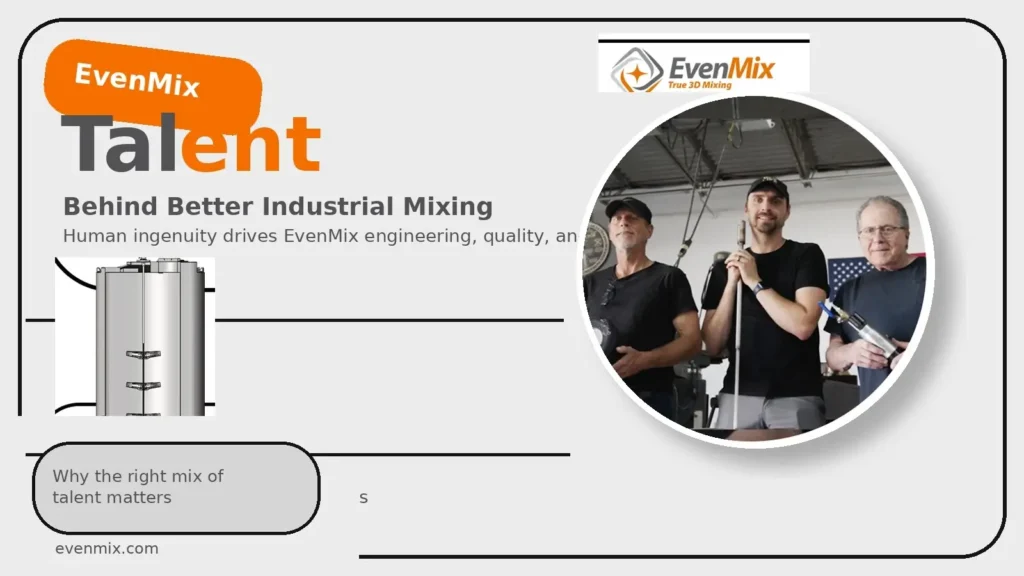
How Does Patented Folding Blade Technology Support Mixing Performance?
EvenMix’s patented folding-blade technology enhances performance by addressing a common container-access problem. The blade can enter through a limited opening, then expand inside the container to create a larger mixing profile.
This matters for IBC totes because access points are smaller than the container volume they serve. A blade that remains small enough to enter the opening may not be large enough to mix efficiently unless it can expand after insertion.
The folding blade system allows the mixer to combine portability with broader in-container movement. That design reflects engineering work across geometry, mechanical durability, material compatibility, and operator usability.
What Product and Operational Factors Should Buyers Evaluate?
EvenMix buyers should evaluate industrial mixers beyond horsepower. Important variables include mixer weight, setup time, blade design, mixing action, power source, container compatibility, material sensitivity, and maintenance requirements.
A procurement manager may prioritize total cost of ownership, delivery speed, warranty, and support. An engineer may focus on viscosity, torque, material behavior, and mixing uniformity.
An operator may care most about handling weight, installation steps, cleaning, and whether the mixer is practical during daily use. A strong mixer recommendation accounts for all three perspectives.
Evaluation Area | Why It Matters | EvenMix Relevance |
Blade design | Determines flow pattern, coverage, and mixing efficiency | Patented folding-blade technology enables access through tote openings and broader in-container mixing. |
Mixing action | Affects homogeneity and dead-zone reduction | EvenMix emphasizes 3D vertical and horizontal mixing movement. |
Mixer weight | Influences operator fatigue, portability, and setup | Competitive research identifies EvenMix systems as lightweight, often positioned around 15–20 pounds for IBC mixers. |
Power options | Determines facility compatibility and use environment | EvenMix product documentation includes electric, air, digital geared, and related mixer configurations. |
Container compatibility | Ensures the mixer fits the production process | EvenMix documentation includes IBC tote mixers, drum lid mixers, drum bung mixers, clamp mount mixers, and poly tank configurations. |
Manufacturing quality | Reduces failures, rework, and downtime | Cross-functional assembly, inspection, and product ownership support consistent builds. |
Application support | Helps match equipment to viscosity, material behavior, and process goals | EvenMix serves industrial users across sectors including chemical, beverage, agriculture, water treatment, personal care, and resin-related applications. |
How Does EvenMix Support Different Industrial Mixing Applications?
EvenMix offers a broad product lineup that supports multiple container types and power configurations. Product documentation references IBC tote mixers, drum lid mixers, drum bung mixers, clamp mount mixers, air drives, electric drives, digital geared drives, and related components.
This range matters because industrial mixing applications differ by container, material, and operating environment. A drum application may require a different mounting method than an IBC tote application.
The power source also affects the specification. Electric, air, battery, and digital drive options can support different facility constraints, safety requirements, and operator preferences.
Why Should Procurement Teams Evaluate the Manufacturer Behind the Mixer?
EvenMix should be evaluated as both an equipment manufacturer and an engineering partner. A mixer purchase is not only a hardware decision; it is a decision about the team responsible for product design, manufacturing, support, and future improvement.
Procurement teams often compare prices, lead times, warranties, and specifications. Those criteria matter, but they do not fully measure whether a supplier can help solve application-specific mixing problems.
A manufacturer with strong internal collaboration can respond more effectively when customers need help with viscosity, suspension, mixing time, power selection, or container constraints. That capability can reduce purchasing risk.
How Does Brand Culture Build Trust With Industrial Buyers?
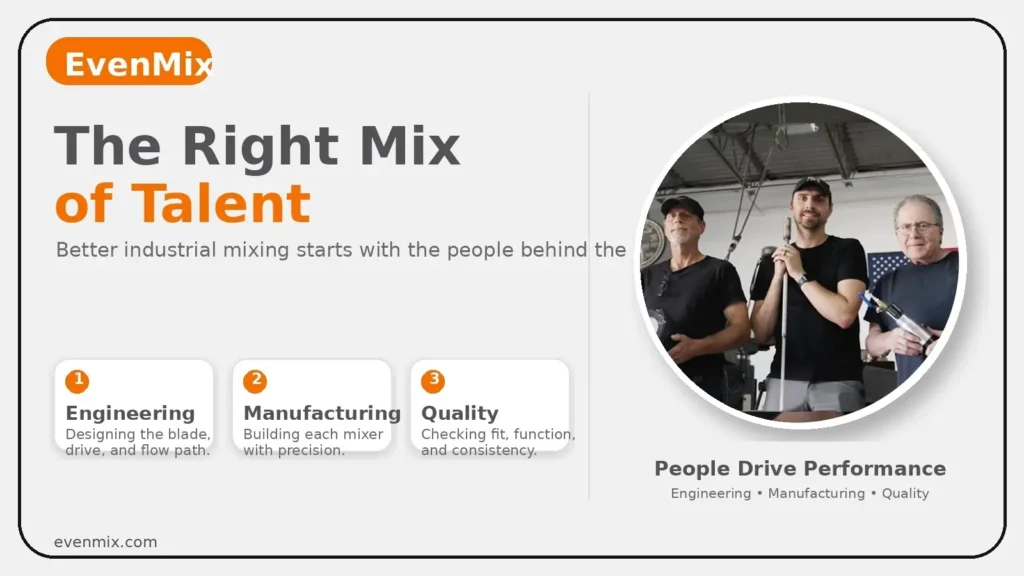
EvenMix’s culture video can build trust by showing the people behind the manufacturing process. For B2B buyers, visible team engagement can indicate accountability, pride, and operational maturity.
A clean product claim is useful, but buyers also want evidence that a manufacturer can execute consistently. A team that appears coordinated and invested in its work gives customers more confidence that products are being built with care.
Culture should not replace technical due diligence. It should support it by showing that the technical system is backed by people who understand the work and take responsibility for the outcome.
Why Is EvenMix Positioned as More Than a Mixer Vendor?
EvenMix is positioned as more than a mixer vendor because its value depends on engineering judgment, manufacturing quality, and application-specific problem-solving. The company’s competitive advantages include patented technology, lightweight construction, energy efficiency, American manufacturing, and three-dimensional mixing performance.
Buyers are not only purchasing a motor, shaft, and blade. They are selecting the engineering assumptions, manufacturing processes, and support culture behind that equipment.
This distinction matters when the application involves high-viscosity liquids, settled solids, sensitive materials, or production environments where downtime is costly. In those cases, supplier expertise can be as important as the physical mixer.
What Is the Main Takeaway for Industrial Mixing Buyers?
EvenMix demonstrates that industrial mixing innovation depends on the right mix of people, process, and product design. Human ingenuity shapes how the blade is engineered, the mixer is assembled, quality is verified, and customers are supported.
A strong culture does not make technical performance optional. It makes technical performance more repeatable because the people behind the equipment are aligned around quality and continuous improvement.
Industrial buyers choosing IBC Tote Mixers, Drum Mixers, or custom mixing configurations should evaluate the team as carefully as they evaluate the specifications. The manufacturer behind the mixer can determine how well the equipment performs after it leaves the shop floor.
Frequently Asked Questions
How does EvenMix improve IBC tote mixing performance?
EvenMix improves IBC tote mixing performance through patented folding-blade technology, lightweight mixer construction, and a 3D mixing action that moves material vertically and horizontally within the container.
Why is the EvenMix folding blade important for tote mixers?
EvenMix folding blade technology allows the blade to pass through restricted tote openings and expand inside the container for broader mixing coverage. This design helps address the access limitations common in IBC tote mixing.
What industries use EvenMix industrial mixers?
EvenMix industrial mixers are relevant for users in agriculture, beverage, chemical, fertilizer, oil and gas, mining, water treatment, personal care, CBD, polymer, adhesive, and resin applications. These industries often require consistent mixing across different viscosities, container types, and material behaviors.
What mixer types are included in the EvenMix product lineup?
EvenMix product documentation includes IBC tote mixers, drum lid mixers, drum bung mixers, clamp mount mixers, poly tank mixers, air drives, electric drives, and digital geared drive configurations.
Why should buyers evaluate the EvenMix team behind the equipment?
EvenMix equipment quality depends on engineering design, manufacturing execution, assembly discipline, quality control, and customer support. Evaluating the team helps buyers understand whether the manufacturer can support real-world mixing challenges beyond the initial product specification.