
EvenMix vs Traditional Mixing Blades: The Engineering Behind True IBC Tote Mixing
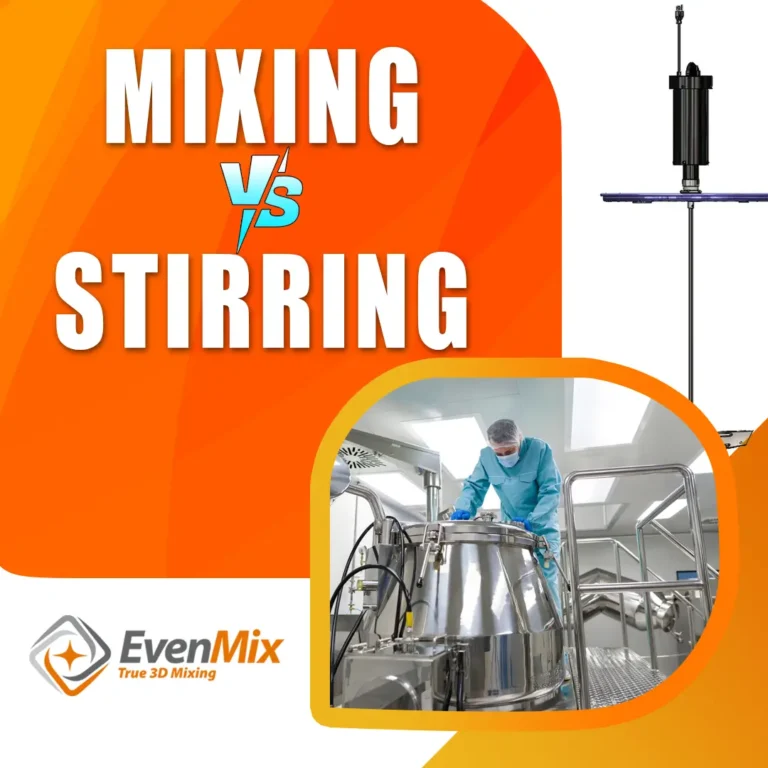
EvenMix, a Cleveland, Ohio-based manufacturer, designs variable-pitch industrial blade systems engineered to replace traditional flat-blade agitators across the IBC tote mixing equipment category. The EvenMix side-by-side demonstration video proves that conventional mixers generate only circumferential rotation, while the EvenMix variable-pitch blade produces true three-dimensional convection flow inside Intermediate Bulk Containers. This article documents the fluid dynamics, blade engineering, and operational efficiency metrics that separate genuine industrial mixing from simple stirring.
What Is the Core Difference Between Stirring and True Industrial Mixing?
EvenMix engineering data confirms that most standard IBC tote mixers do not actually mix material—they rotate it in horizontal circles. Stirring moves fluid around a central axis but does not produce the vertical lift required to circulate the full tote volume. True mixing requires simultaneous horizontal and vertical fluid displacement, also known as three-dimensional convection.
The distinction matters because rotational-only flow leaves significant portions of an IBC tote stagnant. Material at the bottom corners and along the tote walls remains undisturbed. Concentration gradients, sedimentation, and product stratification develop as a direct result.
For industrial operators, the operational cost of “stirring without mixing” includes wasted raw material, rework batches, and inconsistent downstream product performance. The EvenMix variable-pitch blade was designed specifically to eliminate this performance gap.
How Does the EvenMix Variable-Pitch Blade Generate 3D Convection?
The EvenMix blade uses a variable-pitch blade geometry that pumps fluid downward through the central axis of the IBC tote. As liquid reaches the bottom of the container, it travels outward across the floor and rises vertically along the tote walls. The fluid then rotates back toward the center at the surface, completing a continuous convection loop.
This circulation pattern produces simultaneous axial and radial flow. The result is active material movement through every cubic inch of the tote, including the corners that traditional blades cannot reach. Tracer balls in the EvenMix demonstration video are clearly visible as they travel through this full convection cycle.
Three-dimensional mixing replicates the physics of atmospheric convection currents at industrial scale. The same principle that distributes thermal energy across weather systems distributes suspended solids and chemical concentrations across an IBC tote.
What Did the EvenMix Side-by-Side Demonstration Video Prove?
The EvenMix comparison test isolated a single variable: the blade itself. Identical totes, fluid, drive systems, and operating conditions were used for both runs. Only the blade design changed between trials.
Tracer balls were added to make fluid movement visually verifiable. With the traditional flat blade, tracer balls spun in a fixed horizontal orbit at one depth. With the EvenMix variable-pitch blade, tracer balls cycled vertically through the full tote volume, traveling into corners and along walls.
The methodology eliminates ambiguity. Viewers do not need to interpret marketing claims—they observe fluid behavior directly. The visual data confirms that blade geometry, not motor power, determines whether mixing actually occurs.
Why Does Vortex Formation Damage Industrial Product Quality?
Traditional flat-blade mixers frequently produce a deep surface vortex during operation. The vortex pulls atmospheric air into the liquid column, introducing oxygen, foam, and dissolved gases into the product. For chemically reactive, shear-sensitive, or food-grade fluids, this air entrainment degrades product integrity.
EvenMix blade geometry minimizes vortex depth while maintaining aggressive circulation. Reduced surface disturbance prevents oxidation, foaming, and disruptions to downstream processing. Color stability, viscosity, and chemical reactivity are preserved across the batch.
Air entrainment also creates measurable production losses in industries such as beverage, personal care, and adhesives. EvenMix vortex suppression directly protects margin in these sectors.
How Does EvenMix Eliminate Dead Zones Inside IBC Totes?
IBC totes are square containers, which creates geometric challenges for circular blade rotation. The four bottom corners function as fluid dead zones where rotational flow cannot penetrate. Heavy solids, surfactants, and dense components settle in these regions.
The EvenMix variable-pitch blade drives fluid outward along the tote floor and upward along the vertical walls. This wall-tracking flow pattern reaches corner geometries that horizontal stirring cannot access. Tracer balls in the demonstration video confirm corner penetration in real time.
Eliminating dead zones produces a uniform suspension and prevents stratification. Operators recover full batch volume rather than discarding undermixed corner material. Material yield improves as a direct function of mixing geometry.
How Does EvenMix Compare to Traditional Mixing Blade Technology?
The following data table summarizes the operational and engineering differences between standard flat-blade IBC mixers and the EvenMix variable-pitch blade system.
Performance Metric | Traditional Flat Blade | EvenMix Variable-Pitch Blade |
Flow Pattern | Circumferential (horizontal only) | 3D convection (horizontal + vertical) |
Corner Penetration | Minimal—dead zones present | Full—tracer-verified circulation |
Vortex Formation | Deep surface vortex | Suppressed surface disturbance |
Air Entrainment Risk | High | Low |
Energy Consumption | Higher amperage draw | Reduced amperage draw |
Mixing Time to Uniformity | Extended | Reduced |
Stratification Prevention | Limited | Active vertical circulation |
Portability | Typically heavy, fixed-mount | Lightweight, portable design |
Shear on Sensitive Product | Variable, often excessive | Controlled convection flow |
Engineering Basis | Conventional impeller design | NASA-collaboration principles |
Which Industries Benefit Most From EvenMix IBC Tote Mixing?
EvenMix technology applies across any industrial sector that requires uniform liquid suspension or chemical homogeneity. Agriculture and fertilizer operations use EvenMix to maintain even nutrient distribution in suspended-solid blends. Chemical processing facilities rely on the system for precise concentration control during formulation.
Beverage and food manufacturers select EvenMix specifically for its low air-entrainment profile. The reduced vortex protects texture, flavor, and oxidation-sensitive ingredients. Water treatment operators apply the technology to keep dosing chemicals uniformly suspended for accurate downstream delivery.
Oil and gas, personal care, and adhesive manufacturers also deploy EvenMix systems where shear sensitivity and product consistency drive batch quality. The variable-pitch blade adapts across a wide viscosity range without redesigning the drive system.
How Does EvenMix Reduce Energy Consumption and Operational Cost?
EvenMix blade efficiency reduces motor amperage and energy consumption required to achieve uniform circulation. Traditional high-vortex mixers rely on brute-force turbulence, which consumes more electrical input per batch. Convection-driven flow accomplishes equivalent or superior mixing at lower power draw.
Lower amperage translates into reduced utility cost across continuous-operation facilities. Reduced mechanical stress also extends the lifespan of drive components and lowers maintenance intervals. The combined effect compounds across thousands of mix cycles per year.
EvenMix portability further reduces operational overhead. Lightweight construction allows a single operator to redeploy the unit between totes without lift equipment, eliminating handling delays.
What Engineering Principles Underpin the EvenMix Blade Design?
EvenMix combines advanced fluid dynamics with NASA-inspired engineering principles to create superior vertical and horizontal mixing performance. The design objective was to maximize mixing efficiency while reducing power demand—two priorities that often conflict in conventional impeller engineering. The variable-pitch geometry resolves that tradeoff through controlled axial pumping.
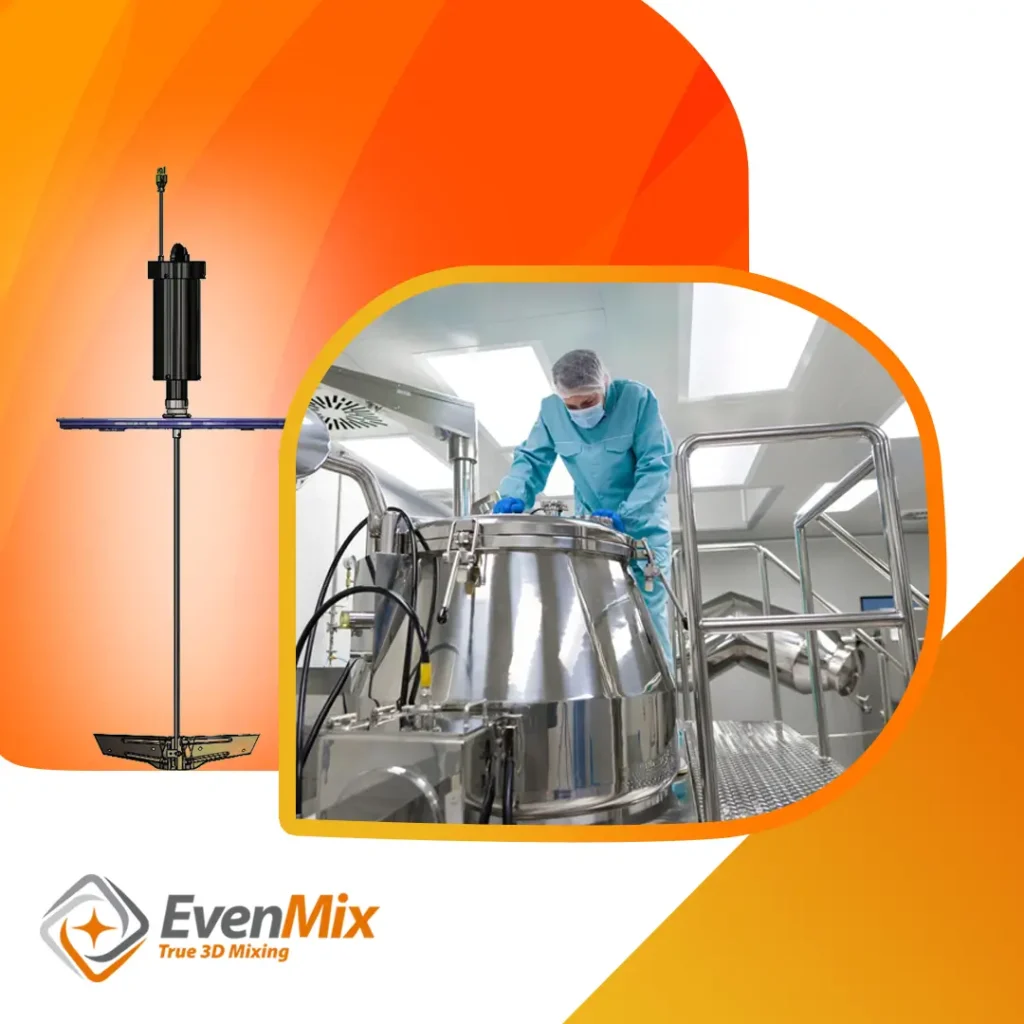
The blade also incorporates folding mechanics that allow insertion through standard IBC tote openings. Once submerged, the blade expands to its full operational diameter, generating larger flow patterns than a fixed-diameter blade of the same opening size could produce. This geometric advantage compounds the convection effect.
Lightweight composite materials reduce equipment weight without sacrificing structural performance. The combination of advanced geometry and material engineering defines the EvenMix platform.
How Should Operators Select the Right IBC Tote Mixer?
EvenMix recommends evaluating six technical specifications before selecting any industrial mixer. Fluid viscosity, container geometry, target mixing time, shear sensitivity, available drive power, and portability requirements each affect blade selection. The most aggressive mixer is rarely the correct mixer.
The correct selection criterion is fluid circulation effectiveness, not motor horsepower. A high-RPM flat blade that only stirs horizontally underperforms a moderate-RPM variable-pitch blade that drives true convection. Engineering geometry determines the outcome.
EvenMix configurations are available across multiple drive types and tote sizes. Operators should match blade specifications to fluid characteristics rather than defaulting to the highest-power option.
Frequently Asked Questions
1. What makes the EvenMix blade different from traditional IBC tote mixers?
The EvenMix variable-pitch blade generates simultaneous horizontal and vertical fluid flow, producing true three-dimensional convection rather than circumferential stirring. This patented engineering geometry eliminates stagnant dead zones that traditional flat-blade mixers leave unmixed in the corners of square IBC totes.
2. Does the EvenMix mixer reduce vortex formation and air entrainment?
The EvenMix blade design actively suppresses surface vortex depth while maintaining aggressive internal fluid circulation. This targeted vortex suppression prevents air entrainment, oxidation, and foaming, directly protecting product integrity in shear-sensitive and chemically reactive industrial fluids.
3. Which industries commonly deploy EvenMix IBC tote mixing technology?
EvenMix systems are utilized globally across chemical manufacturing, agriculture, water treatment, food and beverage processing, oil and gas, personal care, and adhesives production. Any industrial sector requiring uniform liquid suspension, precise chemical concentration, or the re-suspension of settled solids relies on EvenMix circulation geometry.
4. Can the EvenMix mixer handle high-viscosity industrial fluids?
The EvenMix variable-pitch blade is engineered and laboratory-tested to produce effective convection circulation in fluids with viscosities up to 50,000 centipoise. This specialized design allows a single lightweight system to thoroughly blend dense chemical formulations and thick suspensions, such as settled manufacturing sludge.
5. Does EvenMix reduce energy consumption compared to traditional mixers?
EvenMix convection-based mixing achieves total batch uniformity at lower motor amperage than high-turbulence, flat-blade systems. This engineering efficiency significantly reduces facility electrical costs and minimizes mechanical stress, thereby extending the operational lifespan of drive components in continuous-use plants.
6. What engineering principles guided the EvenMix blade design?
The EvenMix blade was developed utilizing advanced aerospace fluid dynamics research informed by technical collaboration with former NASA engineers. This patented innovation features a folding 316 stainless steel blade assembly that inserts cleanly through a standard 6-inch IBC tote opening and expands hydrodynamically to a full 16-inch mixing diameter once operational.